CSS : Pseudo-classe :first-child
La pseudo-classe CSS :first-child sélectionne l'élément s'il est le premier enfant parmi les autres éléments.
Le sélecteur :first-of-type peut être utilisé si l'utilisateur souhaite sélectionner et appliquer un style au premier paragraphe. Le sélecteur :first-child est en fait similaire à :first-of-type, mais il y a une différence : ils correspondent à des conditions différentes. :first-child ne correspond à un élément que s'il est le premier enfant de son parent, tandis que :first-of-type correspond au premier élément de son type spécifique parmi ses frères et sœurs.
Version
Syntaxe
Exemple de syntaxe CSS :first-child
:first-child {
  css declarations;
}
Exemple de la pseudo-classe :first-child avec la balise <p> :
Exemple de code CSS :first-child
<!DOCTYPE html>
<html>
  <head>
    <title>Title of the document</title>
    <style>
      p:first-child {
        background-color: #1c87c9;
        color: #fff;
      }
    </style>
  </head>
  <body>
    <p>Lorem ipsum is simply dummy text...</p>
    <h2>First-child selector example</h2>
    <p>Lorem Ipsum is simply dummy text...</p>
  </body>
</html>Exemple de la pseudo-classe :first-child avec la balise <li> :
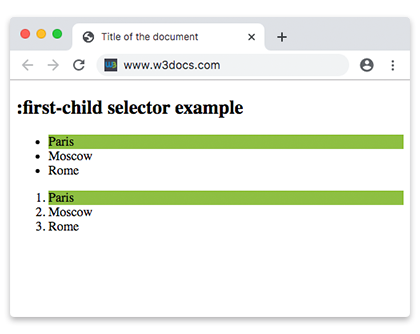
Autre exemple de code CSS :first-child
<!DOCTYPE html>
<html>
  <head>
    <title>Title of the document</title>
    <style>
      li:first-child {
        background: #8ebf42;
      }
    </style>
  </head>
  <body>
    <h2>:first-child selector example</h2>
    <ul>
      <li>Paris</li>
      <li>Moscow</li>
      <li>Rome</li>
    </ul>
    <ol>
      <li>Paris</li>
      <li>Moscow</li>
      <li>Rome</li>
    </ol>
  </body>
</html>Exemple de la pseudo-classe :first-child avec la balise <ol> :
Exemple du sélecteur :first-child avec la balise HTML ol
<!DOCTYPE html>
<html>
  <head>
    <title>Title of the document</title>
    <style>
      ol:first-child {
        background: #8ebf42;
      }
    </style>
  </head>
  <body>
    <ol>
      <li>London</li>
      <li>Paris</li>
      <li>Rome</li>
    </ol>
    <ol>
      <li>London</li>
      <li>Paris</li>
      <li>Rome</li>
    </ol>
  </body>
</html>Exemple de la pseudo-classe :first-child avec la balise <em> :
Exemple du sélecteur :first-child avec la balise HTML em
<!DOCTYPE html>
<html>
  <head>
    <title>Title of the document</title>
    <style>
      p em:first-child {
        background: #82b534;
      }
    </style>
  </head>
  <body>
    <h2>:first-child selector example</h2>
    <article>
      <p>Here is a <em>some</em> text. This is a <em>example</em>.</p>
      <p>Here is a <em>some</em> text. This is a <em>example</em>.</p>
      <p>Here is a <em>some</em> text. This is a <em>example</em>.</p>
    </article>
  </body>
</html>Exemple de la pseudo-classe :first-child avec la balise <ul> :
Exemple du sélecteur :first-child avec la balise HTML ul
<!DOCTYPE html>
<html>
  <head>
    <title>Title of the document</title>
    <style>
      ul li {
        color: blue;
      }
      ul li:first-child {
        color: #8ebf42;
        font-weight: bold;
      }
    </style>
  </head>
  <body>
    <h2>:first-child selector example</h2>
    <ul>
      <li>List Item 1</li>
      <li>List Item 2</li>
      <li>
        List Item 3
        <ul>
          <li>List Item 3.1</li>
          <li>List Item 3.2</li>
          <li>List Item 3.3</li>
        </ul>
      </li>
    </ul>
  </body>
</html>Pratique
Que représente la pseudo-classe :first-child en CSS ?